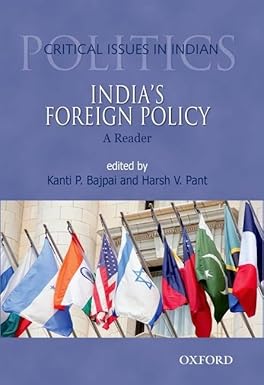
INDIA'S FOREIGN POLICY: A READER BY KANTI P. BAJPAI & HARSH V. PANT (HARDCOVER)
INDIA'S FOREIGN POLICY: A READER BY KANTI P. BAJPAI & HARSH V. PANT (HARDCOVER)
Couldn't load pickup availability
Kanti Bajpai and Harsh V. Pant have edited this book for the benefit of graduate students studying Indian foreign policy, those teaching the subject as well as the general reader interested in its key aspects. It is a compilation of 14 essays, apart from the introduction, written over the last 15 years by noted scholars and specialists, mostly people of Indian origin.
The focus of the book is contemporary foreign policy, which is why the editors have excluded historical writing. India’s relations with Europe, Africa, Latin America, West Asia, Japan, Russia or the UN are excluded too because all these relations are considered of secondary importance in India’s foreign policy, the core of which, in the view of the editors. is relations with China, Pakistan, the US, the extended neighbourhood in Asia as well as WTO and climate change issues. This is a highly contestable view.
The European Union is our largest trading partner and a key player in WTO and climate change negotiations; Russia is our biggest defence partner, 80% of our energy supplies as well as massive remittances come from West Asia, besides this region being critical with regard to issues of terrorism and religious extremism. The geopolitical view of the editors would restrict India essentially to Asia, which also raises the question whether its partnership with the US is in the narrow Asian context or a larger global one.
The book has been structured in four parts, the first dealing with Indian conceptions on how to deal with the world, the second with its power and foreign policy infrastructure, the third with relations with Pakistan, China, the US and the larger neighbourhood encompassing East Asia, Southeast Asia, Central Asia and the Indian Ocean. The fourth focuses on global diplomacy, specifically climate change and WTO negotiations.
In the first section on ideas perfusing Indian foreign policy choices, Raja Mohan, in an article written in 2003, derides India’s nonaligned policy as having been fundamentally wrong and unrealistic in seeking to challenge the domination of the West. It got its comeuppance with the end of the Cold War, with India ending up by being on the losing side. The underlying logic of his argument is that the supremacy of the West is the natural order of things, which NAM tried vainly to resist. Treating NAM contemptuously is one thing, but outlining an alternative policy that India could pursue more profitably after Independence is another, and Raja Mohan offers no ideas on that score. His view that after the end of the Cold War, India actively pursued a multi polar world with the ambition of establishing itself as a pole is questionable. His conclusion that India will look for strategic space within a framework of broad support to the West rather than in an anti-western framework is perceptive, but his belief that India is now open to the idea of alliances and seeks an alliance-like relationship with the US seems more wishful thinking than reality.
Shipping & Returns
Shipping & Returns
- Shipping Time:- Our orders are shipped within 24 Hours.
- Delivery Time:- 2-5 Days (Anywhere in India), 7-10 Days for remote location
- Shipping Partner:- Bluedart, Delhivery, Xpressbees, & India Post.
- Replacement:- Damaged During Transit, Missing Parts Or Item Mismatch.
- Return:- Item mismatch or parts missing etc.
- No return/Replacement will apply if the Product has been subject to misuse, static discharge, neglect, accident, modification, or has been soldered or altered in any way.
- We accept no responsibility for improper installation of our products. Electrical polarity must be properly observed in hooking up electrical components.