
Sound Finder Find the right buzzer, speaker or mic in 2 steps
Active or passive buzzer?
Speaker matcher
| Driver | Speaker to use |
|---|---|
| Arduino pin | Passive buzzer or piezo. For an 8 Ω speaker add a transistor and a 100 Ω resistor. |
| DFPlayer Mini | 4 or 8 Ω, up to 3 W, straight on SPK1 and SPK2 |
| ISD1820 voice module | 8 Ω, 0.5 W |
| LM386 | 8 Ω, 0.5 to 1 W |
| PAM8403 | 4 or 8 Ω, 3 W per side |
| TDA2030 / TPA3116 | 4 or 8 Ω, 10 W and up |
The speaker's watt rating should be the same as or more than the amplifier's output. Ohms should match what the amplifier lists; a lower ohm speaker draws more current and can overheat a small amplifier.
-
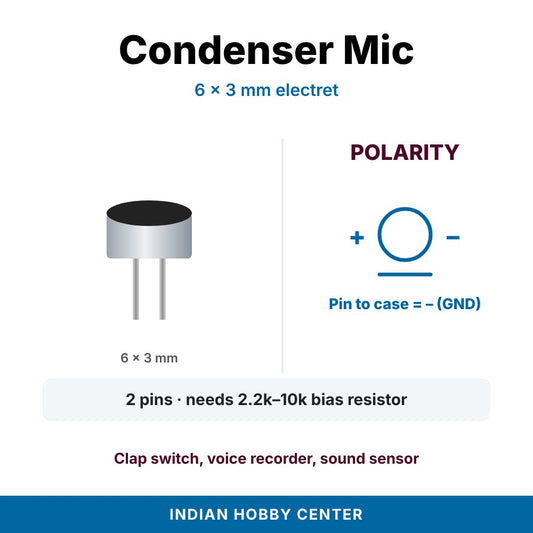
6x3mm Electret Condenser Microphone, 2 Pin (Pack of 1)
Regular price Rs. 10.00Regular price -
9.7x7mm Electret Condenser Microphone, 2 Pin (Pack of 1)
Regular price Rs. 10.00Regular price -
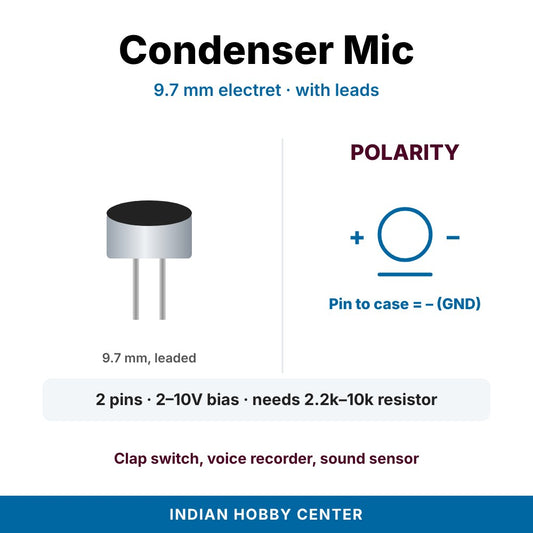
9.7mm Electret Condenser Microphone, 2 Pin with Leads (Pack of 1)
Regular price Rs. 12.00Regular price



About Condenser Microphones
Electret condenser microphone capsules (6 mm and 9.7 mm) for clap switches, voice recorders and sound sensors. The pin joined to the metal case is GND (–). They need a 2.2k-10k bias resistor and usually an amplifier stage.
Shop by brand


